Figure 1. IsomerAPI About dialog. Version 1.4.3 (23-Aug-2026), developed at FRIB/MSU.
Introduction
IsomerAPI is a new utility distributed with the LISE++ package for working with nuclear isomer levels and gamma-ray transitions. The current database contains 79,569 gamma lines for 923 isotopes and provides a modern interface for searching, filtering, and visualizing isomeric decay information.
Isomer information has long been used in LISE++ to estimate gamma rays that may be observed in coincidence with fragments transmitted through a separator and implanted at the final focal plane. The original LISE++ isomer database supported calculations of observable delayed gamma-ray yields using the calculated fragment rate together with isomer half-life, gamma intensity, separator flight time, acquisition time, and detector efficiency. See the historical description: Isomers in LISE++.
IsomerAPI expands this capability with a much larger evaluated data set and an explicit level-to-transition representation. The user can select an isotope region and filter records by mass number A, proton number Z, isomer-level energy, gamma-ray energy, half-life, and data source. Separate displays are available for isomer levels, gamma transitions, or both, with summary statistics for the selected region.
79,569gamma-line records
923isotopes in the current database
Qt / SQLiteutility distributed with LISE++
Current status. IsomerAPI is included in the LISE++ package and can be launched from the LISE++ toolbar or from Utilities → Codes. At present it operates as a standalone application: LISE++ calculations and the IsomerAPI database are not yet connected directly.
How it works. IsomerAPI reads the evaluated isomer/gamma information from an SQLite database, applies the requested isotope and decay filters, and organizes the selected records as isotopes, energy levels, and gamma transitions. The same prepared data are used for the visible tables, summary statistics, and decay-scheme drawing.
Planned LISE++ integration. The original LISE++ isomer-database interface will be replaced by the new data and reusable IsomerAPI source functions. These functions will be called directly inside LISE++, rather than launching the standalone code, so predicted fragment yields and transmission can be connected directly with modern isomer and gamma-transition information.
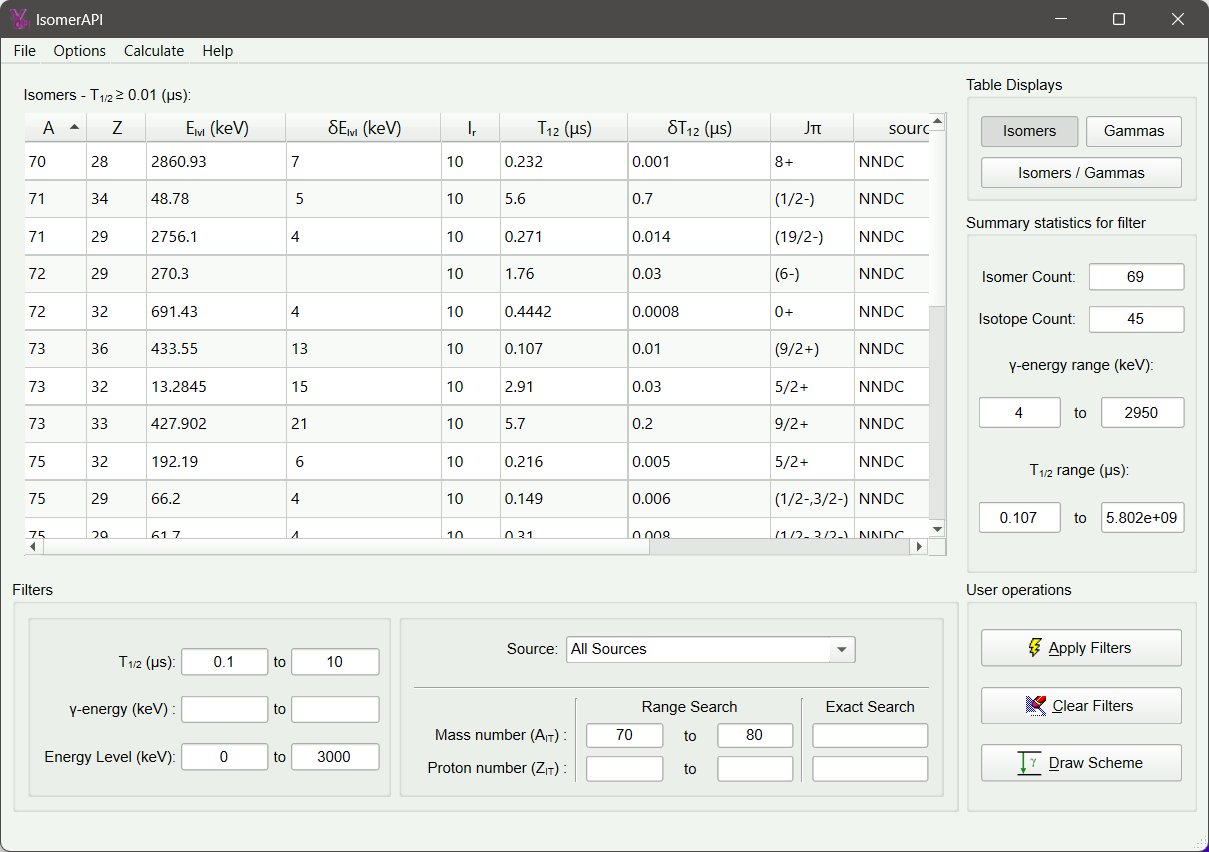
The main window combines database tables with exact and range searches. Typical use is to first restrict the isotope region in A and Z, then apply half-life, level-energy, gamma-energy, and source filters. The result can be inspected as isomer levels, gamma transitions, or a split Isomers/Gammas view.
Isomer search: find candidate metastable levels and their half-lives.
Gamma search: identify transition energies, intensities, and associated levels.
Region selection: search one isotope or a broader separator/experiment region.
Summary statistics: report the number of selected isomers/isotopes and the resulting gamma-energy and half-life ranges.
Figure 2. Main IsomerAPI window. The table shows filtered isomer-level records; the lower and right panels provide A/Z, half-life, level-energy, gamma-energy, and source selection together with summary statistics for the active filter.
Decay-scheme visualization
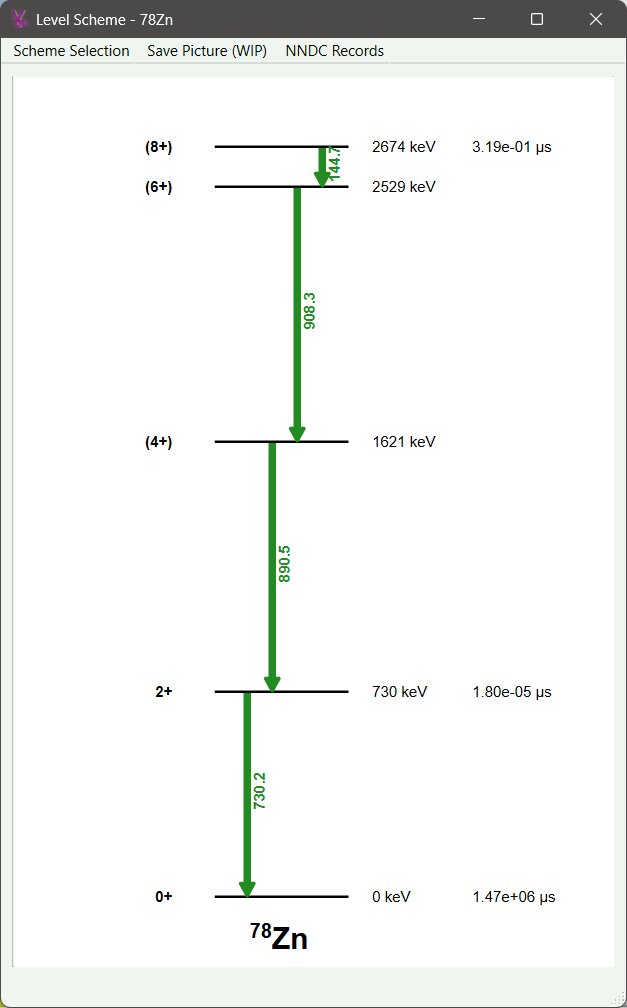
The Draw Scheme function constructs a level scheme for a selected isotope from the connected level and gamma-transition records. The plot displays excitation energies, spin/parity information, half-lives, and gamma transitions. This gives a quick visual check of which delayed gamma rays may be useful for identifying an implanted fragment.
The scheme window also provides isotope selection and links to the corresponding NNDC records for comparison with the evaluated source data.
Figure 3. Example level scheme for 78Zn. The 2674-keV isomeric state and the subsequent gamma-ray cascade are shown with level energies, spin/parity assignments, half-lives, and transition energies.