 ,
/1/
,
/1/1. Reduction of fragment output due to reactions
1. Reduction of fragment output due to reactions
In the new version of the program, losses from reactions in a target, stripper, and wedge, as well as contributions from secondary reactions to fragment output, are treated more accurately. In previous versions, the simple dependence for the formation of reaction products was used; this is true only when the target thickness is assumed to be small:
,
/1/1.1. Reactions in a target (stripper)
As the target thickness is increased, the probabilities of destroying the fragment of interest and the projectile become significant. These probabilities are governed, respectively, by the total cross-sections of the fragment sF and the projectile sP. Taking this into account, the number of fragments F is determined as:
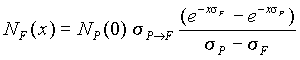 . /2/
. /2/ .
/3/
.
/3/1.2. Reactions in a wedge
In the new version of the program, losses in the number of fragments due
to reactions in a wedge are also taken into account. A new coefficient,
number 23, was introduced to show the ratio of lost fragments to the total
number produced in a wedge, where x is the wedge thickness 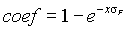 .
.
1.3. Reactions in materials
The user can also view the treatment of reactions in materials in the "GOODIES" dialog, shown in Fig.2. It is possible to observe both the loss in a given material (A) and the percentage of fragments remaining from the initial number produced in the telescope.
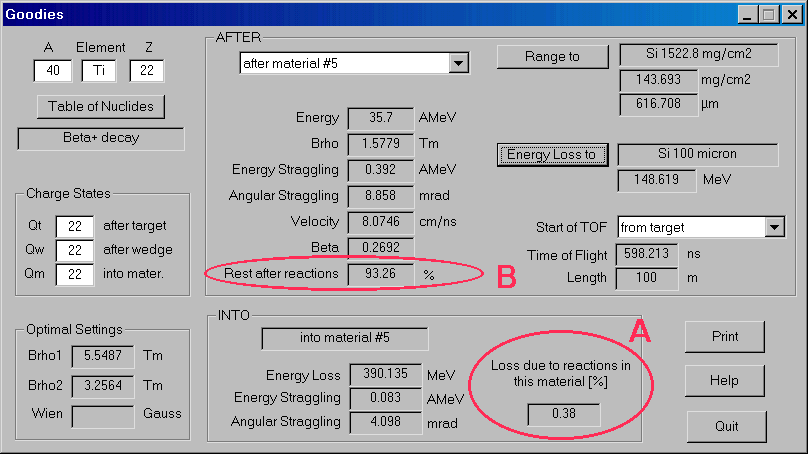
Fig.2. "GOODIES" dialog: calculation of reactions
in materials
2. Calculation of secondary-reaction contributions to fragment output
In version 4.7, the user could plot the contribution of secondary reactions for only one fragment. In the new version, the contribution of secondary reactions for all selected projectile-fragmentation products can be taken into account directly during the transmission calculation. To apply the secondary-reaction calculation, it is necessary to enable the appropriate option (A) in the PREFERENCES menu (see Fig.3).
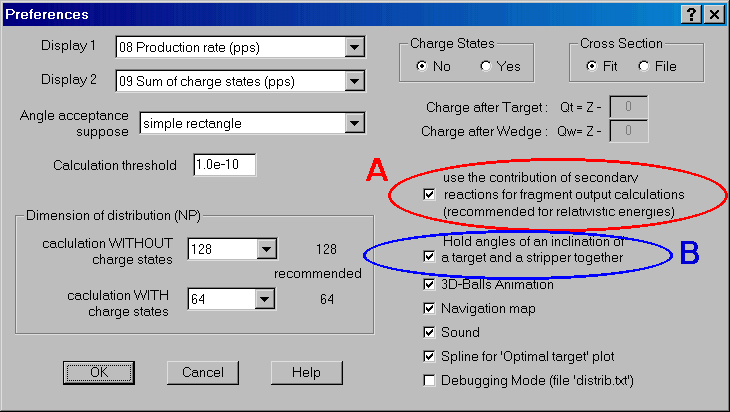
Fig.3. Preferences dialog
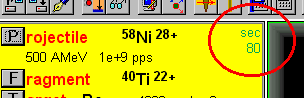
In secondary-reaction calculation mode, the green flag SEC appears in the upper right corner of the SETTINGS window (see Fig.4). The number under this flag indicates the number of fragments included in the calculation of the secondary-reaction contribution.
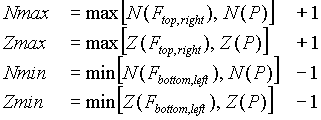
Arrays of fragment outputs after the target as a function of target thickness are stored in memory. They are deleted if the target thickness decreases by a factor of 5, increases by a factor of 2, or if the energy of the initial beam changes by 10 percent. If the new target thickness satisfies the above conditions, the fragment output is interpolated from the saved arrays. When the user sets the region of nuclei (Ftop,right, Fbottom,left) for the transmission calculation, the program determines a new square for the calculation of secondary reactions, taking into account that the projectile (P) must also belong to this region. The program then expands the given square by one unit on all sides:
 , /4/
, /4/To include the secondary-reaction contribution, a new transmission coefficient, number 24, was introduced. The algorithm for calculating the secondary-reaction contribution also takes into account output losses in the target and stripper. However, coefficient 22, described in the previous paragraph, also accounts for these losses. To avoid double counting losses caused by reactions in targets, coefficient 24 is written as follows:
2.1. Secondary reactions and the optimal-target calculation subroutine
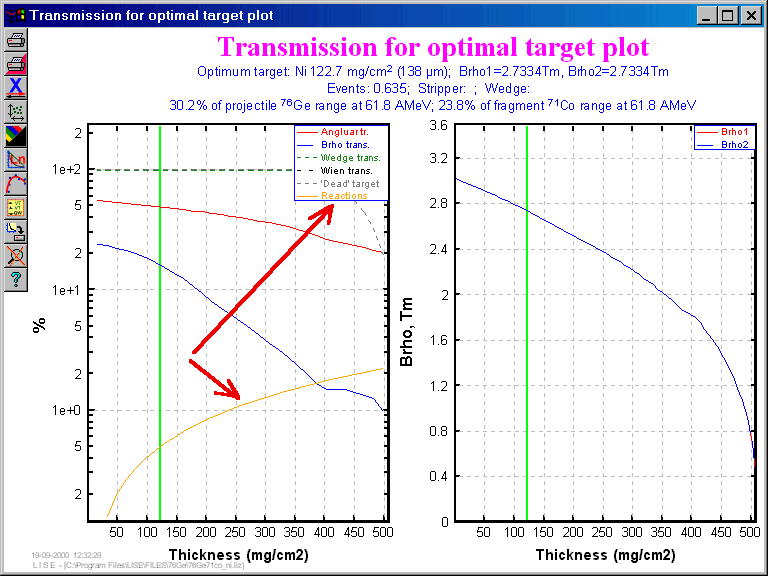
The new version of the program also allows the contribution of secondary reactions to be taken into account when calculating the optimal target thickness. If the initial beam energy is greater than 200 AMeV, or if the "Secondary Reactions" option is enabled, the program automatically offers to calculate the thickness taking secondary reactions into account. The user can disable this option (see Fig.5). For comparison, the plot shows fragment outputs as a function of target thickness both with and without secondary reactions (see Fig.6).
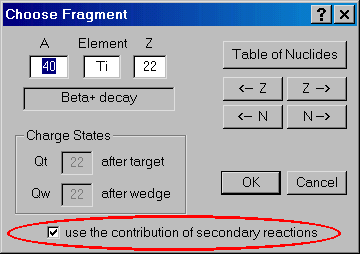
Fig.5.
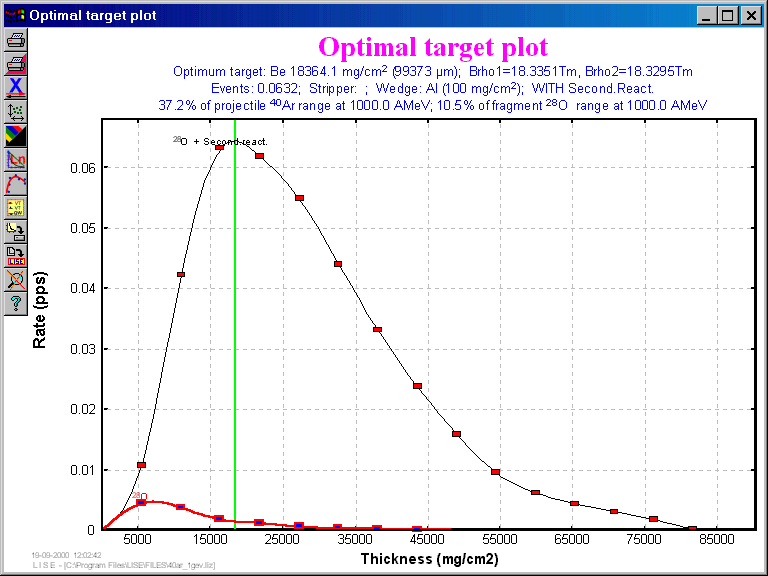
Fig.6. Optimal target plot with contribution of secondary
reactions.
3.1. New random-number generator
In the new version of the program, the random-number generator was replaced with a more advanced one. The range of the new generator extends up to 232-1, which allows better simulation of two-dimensional plots in Monte Carlo acquisition mode.
3.2. Creation of a file with secondary-reaction contribution results
Using the plot "Output of products from a target with the contribution of secondary reactions" through the "Utilities" menu, the user can access a file containing the calculation results for fragment outputs with the contribution of secondary reactions included (see Fig.7). This file is located in the LISE root directory and is called "contribution.txt".
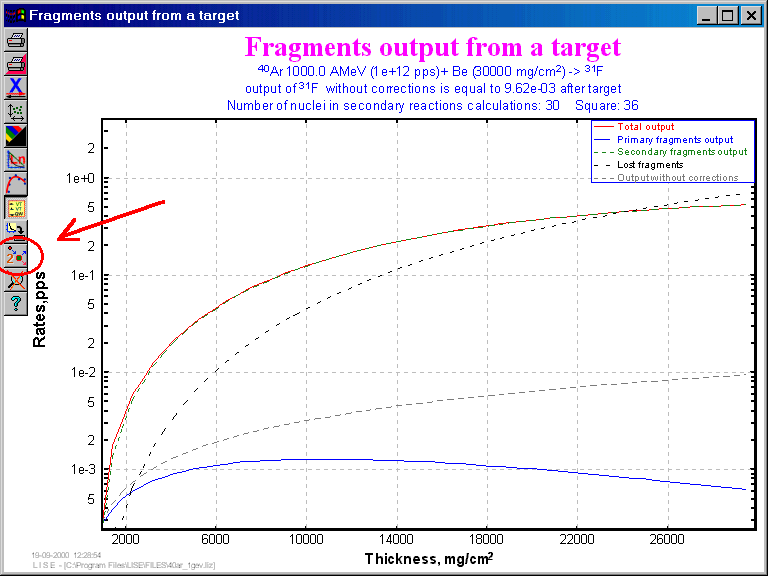
Fig.7. Calling the results file through the plot "Output
of products from a target with the contribution of secondary reactions".
This file shows which fragments give the largest contribution to the fragment of interest through secondary reactions. It also allows the user to analyze the difference between fragment outputs without corrections, based on formula /1/, and outputs calculated with secondary reactions included. From this example, it is possible to conclude which fragments have an advantage at relativistic energies when a thick target is used.
An example of this file for the fragment 31F is given below:
========================================================================
CONTRIBUTION OF SECONDARY REACTIONS in output of
31F
=========================================================================
| | | | |
A | B
| C | B/C | relation
|
A El| Z | N |contribution | fragment's
| fragment's | |SECONDARY/|
| | | | |from fragment|output
with |output w/out| | PRIMARY
|
| | | | | into 31F
| secondary |any correct.| |
after |
| | | | | w/out loss
| reactions | (pps) |
| target |
=========================================================================
40Ar| 18| 22| 6.03e-04 | 5.64e+10 | 1.00e+12 | 0.056
| 0.0014 |
42K | 19| 23| 4.45e-07 | 8.59e+07 | 1.56e+09 | 0.055
| 0.1488 |
41K | 19| 22| 7.73e-08 | 1.62e+08 | 2.64e+09 | 0.061
| 0.2596 |
40K | 19| 21| 6.09e-08 | 5.78e+08 | 9.81e+09 | 0.059
| 0.1898 |
41Ar| 18| 23| 9.91e-05 | 5.47e+08 | 9.81e+09 | 0.056
| 0.1356 |
39Ar| 18| 21| 2.18e-06 | 8.10e+09 | 1.40e+11 | 0.058
| 0.1413 |
40Cl| 17| 23| 1.01e-03 | 1.70e+08 | 2.64e+09 | 0.064
| 0.2797 |
39Cl| 17| 22| 1.60e-03 | 2.23e+09 | 3.78e+10 | 0.059
| 0.1577 |
38Cl| 17| 21| 6.16e-05 | 4.07e+09 | 6.35e+10 | 0.064
| 0.2356 |
39S | 16| 23| 3.42e-03 | 1.97e+07 | 2.18e+08 | 0.090
| 0.7564 |
38S | 16| 22| 6.98e-03 | 2.38e+08 | 3.12e+09 | 0.076
| 0.4587 |
37S | 16| 21| 6.57e-04 | 7.68e+08 | 9.93e+09 | 0.077
| 0.4553 |
38P | 15| 23| 7.30e-03 | 1.61e+06 | 9.82e+06 | 0.164
| 2.1123 |
37P | 15| 22| 2.57e-02 | 2.16e+07 | 2.08e+08 | 0.104
| 0.9416 |
36P | 15| 21| 5.29e-03 | 1.03e+08 | 1.10e+09 | 0.094
| 0.7220 |
37Si| 14| 23| 1.39e-02 | 1.22e+05 | 3.77e+05 | 0.323
| 4.9994 |
36Si| 14| 22| 7.52e-02 | 1.70e+06 | 1.13e+07 | 0.151
| 1.7554 |
35Si| 14| 21| 2.94e-02 | 1.02e+07 | 8.44e+07 | 0.121
| 1.1659 |
36Al| 13| 23| 2.09e-02 | 8.29e+03 | 1.13e+04 | 0.737
| 12.3321 |
35Al| 13| 22| 1.46e-01 | 1.12e+05 | 4.21e+05 | 0.266
| 3.7289 |
34Al| 13| 21| 8.22e-02 | 7.37e+05 | 3.95e+06 | 0.187
| 2.2621 |
35Mg| 12| 23| 2.17e-02 | 4.95e+02 | 1.92e+02 | 2.582
| 44.5410 |
34Mg| 12| 22| 1.79e-01 | 6.30e+03 | 9.49e+03 | 0.664
| 10.5002 |
33Mg| 12| 21| 9.95e-02 | 4.27e+04 | 1.18e+05 | 0.363
| 5.1821 |
34Na| 11| 23| 1.47e-02 | 2.60e+01 | 2.01e+00 |12.901
| 220.689 |
33Na| 11| 22| 1.80e-01 | 3.16e+02 | 1.38e+02 | 2.289
| 37.6172 |
32Na| 11| 21| 9.39e-02 | 2.11e+03 | 2.36e+03 | 0.895
| 13.8098 |
32Ne| 10| 22| 1.40e-01 | 1.40e+01 | 1.39e+00 |10.077
| 164.348 |
31Ne| 10| 21| 6.90e-02 | 9.01e+01 | 3.20e+01 | 2.819
| 44.3615 |
31F | 9| 22| 4.68e-02 | 5.39e-01 | 9.62e-03 |56.013
| 892.3932 |
=========================================================================
Characteristics of fragment output ( 31F ) after
target
Total output 5.39e-01
Primary fragments output 6.03e-04
Secondary fragments output 5.38e-01
Lost fragments 7.28e-01
Output without corrections 9.62e-03
By clicking the left mouse button in the About dialog, the user automatically opens a browser and loads the LISE program homepage at the address: http://lise.frib.msu.edu. In future versions, an automatic check for the presence of a new version of the LISE program on the appropriate servers is planned.
3.4. Inclination angles of a target and a stripper
In the new version, the user can set an option in the "Preferences" menu (see Fig.3, ellipse B) for simultaneous rotation of the target and stripper when the target is rotated. If the user changes the inclination angle of the target, the inclination angle of the stripper will also be changed automatically, and the user will receive a message about it. If this option is enabled, the optimal target thickness as a function of target inclination will also be calculated under the condition of simultaneous inclination of the target and stripper (see the following paragraph).
3.5. Calculation of optimal target thickness from target inclination
In the new version, the user can calculate the optimal inclination angle of a target, either with or without simultaneous stripper inclination (see above). This utility can be called through the "Calculations" menu (Fig.8). For this calculation, the initial detector thicknesses are taken at an inclination angle of 0 degrees. This procedure can also work with the "Secondary reactions" and "Charge states" options. An example of the calculation is given in Fig.9.
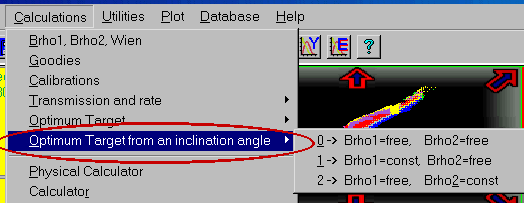
Fig.8.
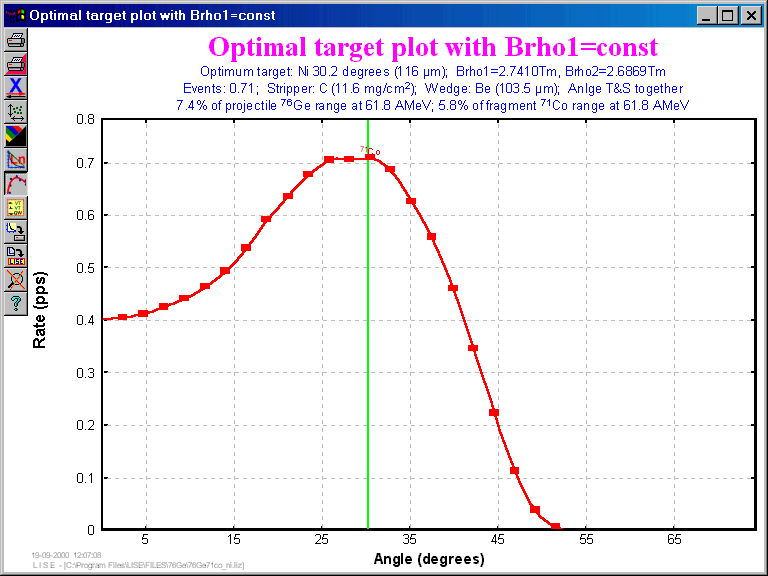
Fig.9. Plot of optimal target thickness as a function of
target inclination
3.6. Transmission calculation results file
In the transmission calculation results file, the inclination angles of the target, stripper, wedge, and materials, along with their corresponding thicknesses at 0 degrees, are now included. The factor K (equation /6/), which shows the change in fragment output due to reactions in the target, stripper, and wedge, has also been added.